Why Most AI Strategies Fail: AI Strategy as Operating Model Design
· 4 min read

· 4 min read
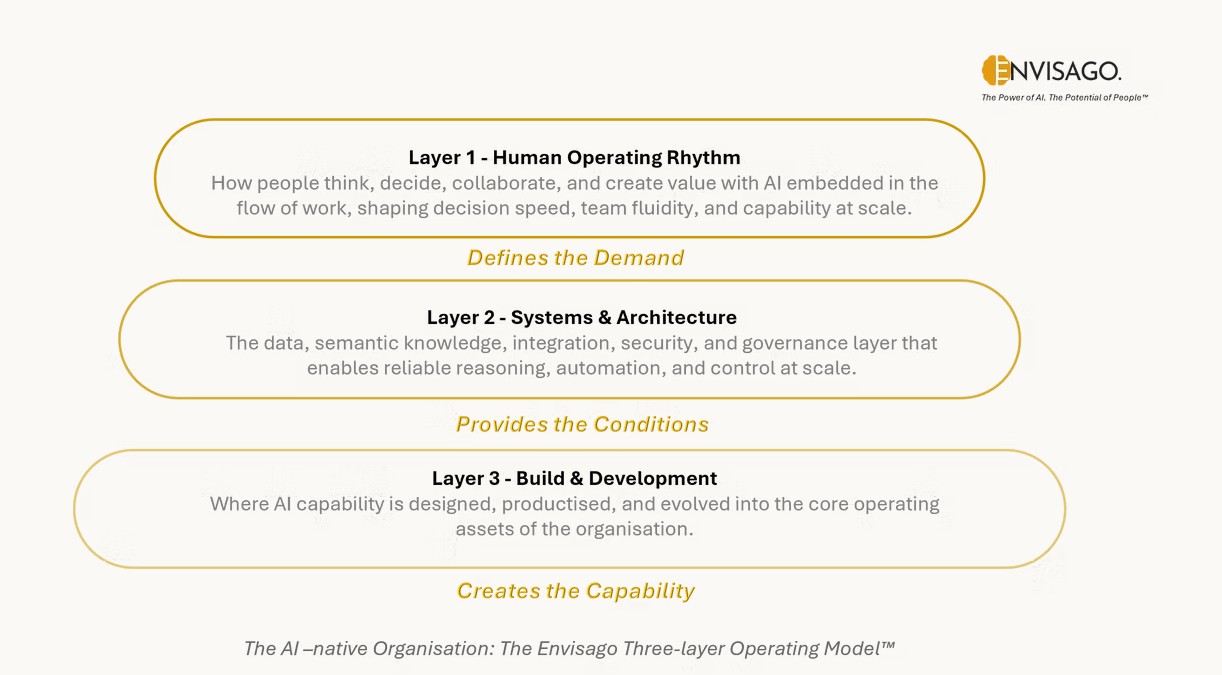
Most AI strategies fail for a reason that has little to do with the technology. They are written as technology acquisition plans, drafted apart from the systems, structures and behaviours they are meant to change. When a strategy commits the organisation to new tools before it has built coherence in how the work is designed, the cost shows up early, in the space between ambition and design.
The failure is rarely the model or the platform. AI enters a live human system shaped by legacy processes, informal norms, capability gaps and decision rights that may no longer serve the work, and it magnifies whatever it finds. When strategy treats AI as a technology decision rather than a structural one, the same pattern recurs: friction between teams, misalignment at the leadership level, and rework that begins before implementation does. MIT's 2025 State of AI in Business research put a number on it, finding that around 95 per cent of enterprise generative AI pilots reached no measurable impact, with the shortfall traced to integration rather than to the tools. The pilots were introduced without being built into decision-making, workflow design and everyday ways of working.
Because the foundational question tends to go unasked: what has to be true of us, as an operation, for AI to create sustained value? Three conditions usually decide the outcome, and each is a matter of design rather than procurement. The first is leadership fluency in the behavioural shifts AI asks for, rather than in the tools. The second is a clear read of where judgement lives across the work, and of how people can create value alongside AI rather than around it. The third is operating rhythm, the cadence at which decisions, collaboration and feedback move. Most strategies assume these are already stable, when in practice they have to be aligned deliberately, and that alignment is the work that precedes any meaningful technology choice.
Work gets built in the wrong order. The organisation produces AI outputs without clear human inputs, adopts tools that do not match the speed of its own decisions, and automates before it is clear on what matters. Read as a technology problem, this invites a technology response, more platforms and more integration, when the constraint sits in how the operation is designed. This is where AIVOM's Design dimension does its work: workflow design, data and systems readiness, operational knowledge and governance are settled first, so the build lands on prepared ground rather than on assumptions.
It seldom does. The real differentiator is organisational readiness, the internal conditions that let AI create value: clear thinking across teams and leadership, an honest map of where judgement matters most, and workflows where people and AI contribute in complementary ways. These are embedded capabilities rather than training events, and the pattern we see is that they need to be present before the technology arrives, not assembled in its wake. Capability, in AIVOM, is a dimension in its own right for exactly this reason.
AI magnifies the design of the system it enters; on its own, it does not repair it.
It begins with the operating reality, stated plainly. If decision cycles are slow, AI will not accelerate them, and if workflows are undocumented, it cannot augment them; where leadership direction is unclear, AI tends to amplify that rather than resolve it. The strongest strategies confront this early. Before a technology roadmap, they write a capability and alignment one that names the work to be redesigned, the places where human judgement should lead, the points where AI can accelerate insight, and the structures that have to shift for the two to work together. That is what it means to treat AI strategy as operating model design, and it is where strategic alignment, the first move within the Value dimension of AIVOM, is either won or lost.
The shift is small to describe and large to make: from asking what our AI plan is, to asking what we need to become for AI to serve the work well. Answered at the level of the operating model, an AI strategy lands with force and fluency. Answered as procurement, it produces pilots no one owns and change no one sustains.
The Power of AI. The Potential of People™.
AI Operating Model Design, made practical. From AI deployment to operating impact and enterprise value with AIVOM™. Start with the free AI Operating Impact Briefing at envisago.com.