
The architecture behind AIVOM™
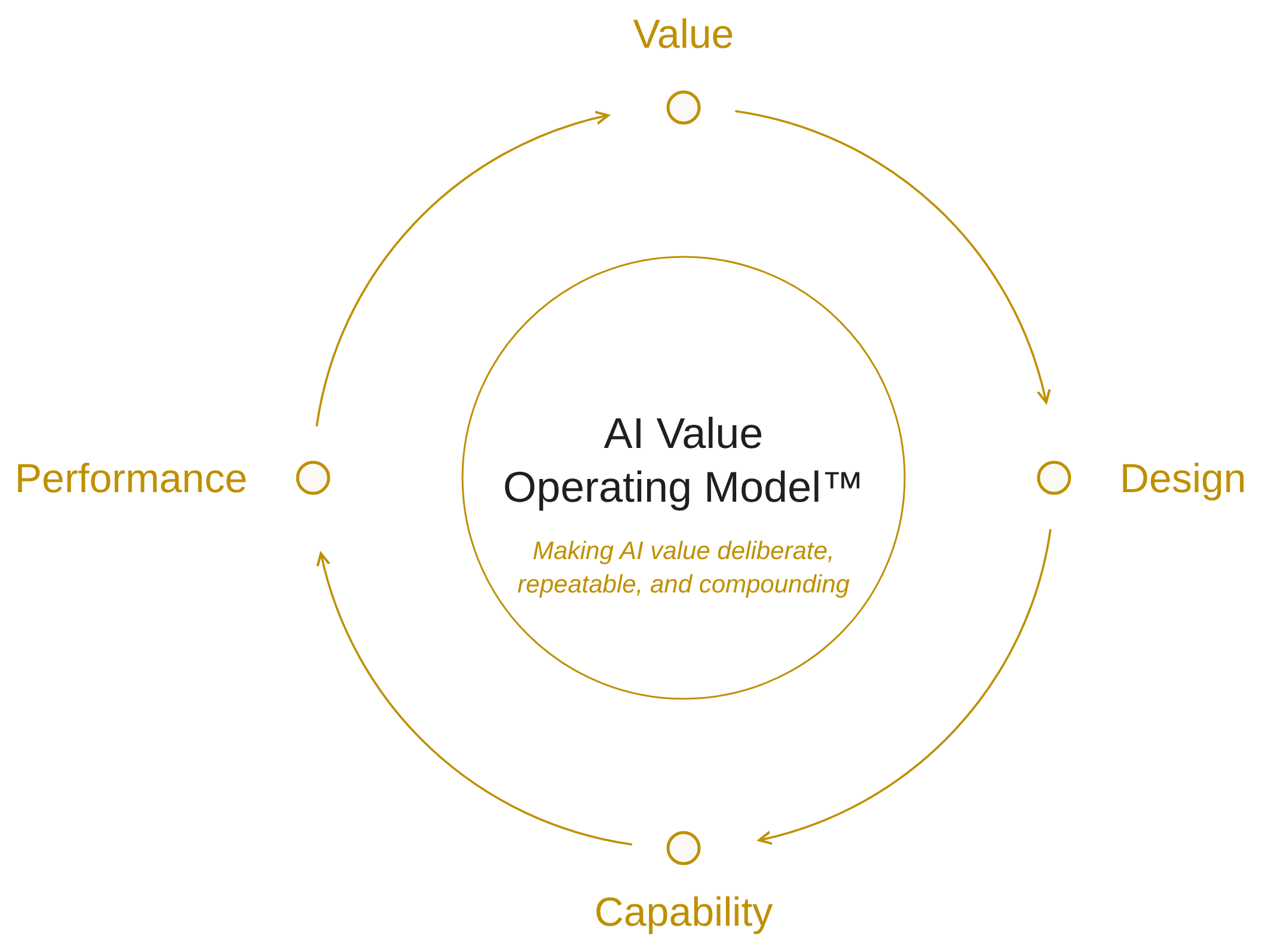
AIVOM™ is a maintained system of four connected dimensions, twenty sub-dimensions and over ninety components. It is designed to show where an operation stands with AI, what is constraining operating impact and where to focus next.


What this document explains
AI changes more than the tools. It changes how work flows, where judgement sits, what people need to be able to do, how quality is managed and how performance is evidenced. AIVOM™ brings those conditions into one connected operating loop so they can be understood and acted on together.
The existing AIVOM™ page explains what the system is and why it matters. This page, and the public architecture document it carries, explain how the system is structured, how a reading is produced and why the method can be trusted.
One loop. Four dimensions. Twenty sub-dimensions. Over ninety components.
The loop and four dimensions provide the stable core. The twenty sub-dimensions, presented across the products as areas of operation, organise the operating conditions inside each dimension. The component layer provides the depth needed to interpret what each state means, what may be constraining impact and what progressing requires.
Value
The value being sought, how it aligns to direction and whether it is owned and evidenced.
- Strategic alignment
- Value goals
- Investment and cost visibility
- Accountability
- Value evidence
Design
How the operation works with AI, including workflows, information, quality and governance.
- Workflow design
- Data and systems readiness
- Operational knowledge readiness
- Quality architecture
- Governance
Capability
How roles, responsibilities, judgement and the ability to sustain AI-enabled work are changing.
- Culture and readiness
- Training and development
- Capability distribution
- Role redesign
- People performance
Performance
What results are tracked and whether AI is delivering the value the operation set out to create.
- Financial performance
- Operational performance tracking
- Experience tracking
- Innovation and new value
- Performance-to-value evidence
The architecture stays recognisable while the reference develops. Sub-dimension names and definitions can be refined as operating practice changes. The component layer is expected to expand more frequently, as new requirements develop.
From structured input to an ordered starting point
The wording can vary; the method beneath it does not. AIVOM™ sets what is examined, what the states mean and how the dimensions are read together. AI personalises the explanation within those boundaries.
Defined states for the dimensions and the loop
A state describes the operating conditions currently in place within the scope being read. It is not a judgement on the organisation as a whole.
These are not maturity stages, and there is no score to climb. A state is read within its scope, the loop is read through its most constraining dimension, and the reference itself keeps moving.
Value clarity
Operating design
Capability readiness
Performance evidence
The AIVOM™ Loop State
The system-level reading is gated rather than averaged: a connected operating loop cannot be stronger than the dimension currently constraining it.
The operation is read as a connected whole
AIVOM™ does not treat Value, Design, Capability and Performance as independent workstreams. A constraint in one changes what is possible in the others. The relational reading examines dependencies, tensions and reinforcing conditions across the profile.
The purpose is not to improve everything at once. AIVOM™ identifies the priority areas that matter most in context, then identifies the binding constraint: the one condition most holding the loop back and needing to move first.
Benchmarking designed for continuous improvement
AIVOM™ benchmarks the operation against maintained operating states, its own earlier baseline and the value and performance goals it set out to achieve. The purpose is to show whether the conditions around AI are developing, whether the loop is strengthening and whether AI is producing the intended operating impact.
The emphasis is on internal continuous improvement rather than broad peer comparison. AI is placed differently in every operation: within different workflows, at different levels of autonomy and with different data, quality, governance and human judgement requirements. Headline comparison between organisations can therefore obscure more than it reveals unless that context is properly controlled.
Current position
Where the operation stands against the latest AIVOM™ states.
Progress from baseline
What has moved since the earlier reading and whether the priorities have changed.
Performance against goals
Whether AI is producing the value and operating impact the operation set out to achieve.
External data may add useful context as AIVOM™ develops, but it does not replace the operation’s own evidence of progress and impact.
A living reference, governed over time
AI-enabled operating practice will continue to move. AIVOM™ is designed to move with it. The four dimensions provide the stable architecture, the twenty sub-dimensions are maintained and the component layer can expand as new operating requirements emerge.
Each new reading uses the latest AIVOM™ reference so the operation is read against current expectations. The earlier reading remains its baseline. Where the reference has changed materially, AIVOM™ separates movement in the operation from movement in the reference and uses a valid crosswalk where one is available.
The architecture stays recognisable, the reference keeps moving and the operation keeps moving with it.
See where your operation stands
The free AI Operating Impact Briefing gives you a personalised, structured read across the AIVOM™ Loop, your priority areas, how they connect and one clear place to begin. It takes about twelve minutes.
For questions about the architecture, contact hello@envisago.com.
Subscribe to The Envisago Compass
Weekly insights on AI Operating Model Design.